


Estimated reading time: 6 minutes
On 26 August 2026, Meta, the owner of Facebook and Instagram, announced a settlement package valued at approximately $18 billion with US state and territorial attorneys general. Its shares rose by 31.86% over the following month. For institutional investors, the case raises a practical question: can seeking compensation for past losses be consistent with remaining invested in a company?
This final article in our three-part series examines the implications for investors considering UK securities claims.
Our previous articles examine the Meta case through the lenses of:
On 26 August 2026, a federal court in California entered a consent judgment giving effect to Meta’s settlement with US state and territorial attorneys general. The settlement resolved most, but not all, of their claims concerning the alleged effects of Facebook and Instagram on children and teenagers. The allegations concerned harmful platform design, misleading statements about the risks and the unlawful collection of data from children under 13. Meta denied the allegations and admitted no liability.
Meta valued its broader agreement with 52 attorneys general at approximately $18 billion, payable over ten years. It said $12.7 billion was guaranteed, with a further $5.3 billion dependent on specified conditions involving TikTok and YouTube.
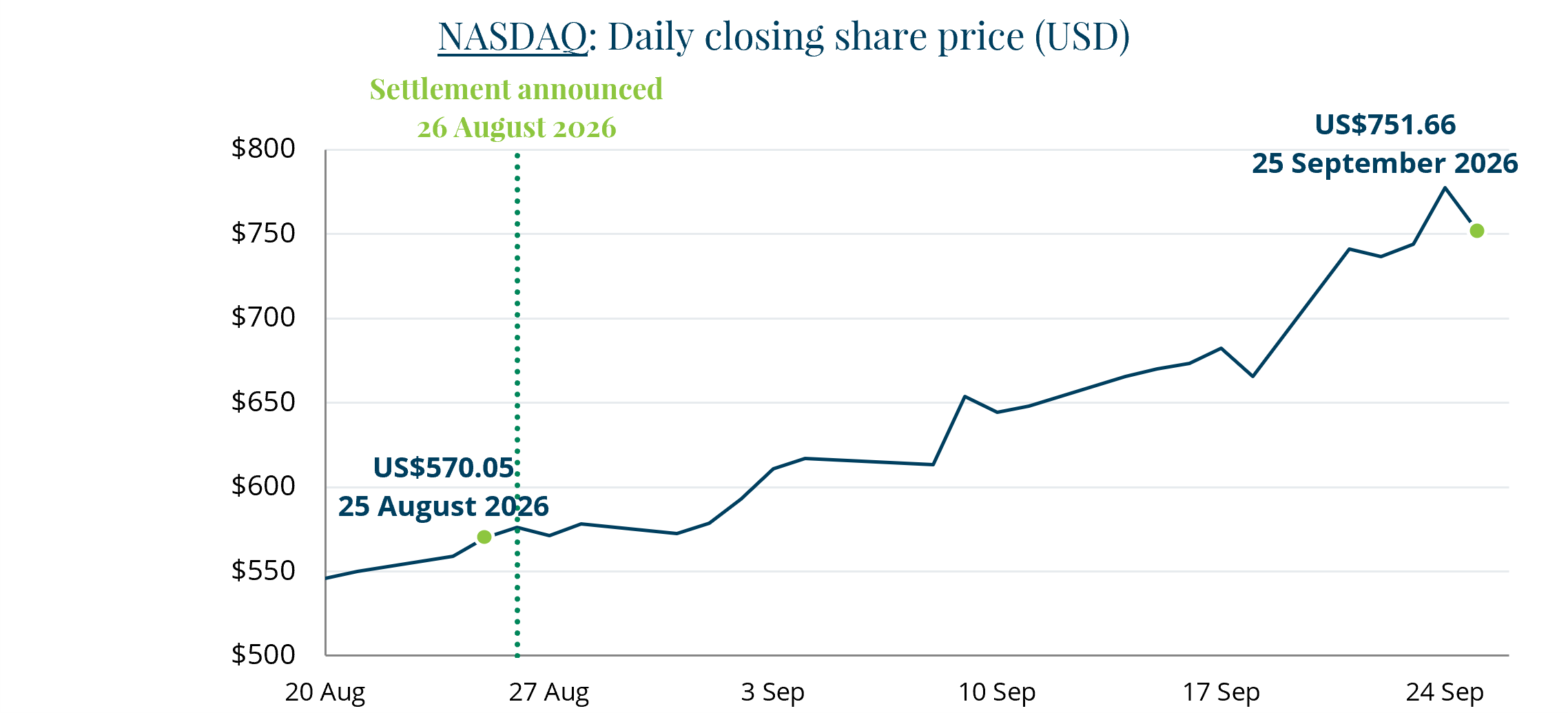
Meta’s Nasdaq-listed shares rose substantially in the month following the announcement. They closed at $570.05 on 25 August 2026, the day before the announcement, and at $751.66 on 25 September 2026 – an increase of 31.86%.
That rise alone does not establish the settlement’s effect on the share price. These proceedings were also brought by public authorities, not shareholders, so the comparison with a securities class action is illustrative rather than direct. The settlement nevertheless highlights a potential benefit of resolving major litigation: reducing uncertainty for investors.
The relevant comparison for investors is usually the settlement against the range of outcomes already reflected in the share price, not against a cost-free outcome. A large payment may be received positively if it replaces a more damaging or less predictable risk with a defined obligation.
Meta expected a Q3 2026 legal expense of approximately $10 billion. This reflected the guaranteed future payments discounted to their present value, less amounts already recognised in its accounts. The charge was not included in its previous expense guidance. Other guidance remained unchanged.
The agreement also introduced non-monetary protections that apply by default to teenage users in participating jurisdictions, including a two-hour daily limit across Facebook and Instagram, overnight restrictions, age-assurance measures and parental controls.
Meta said teenagers account for less than 1% of its revenue. This provides context for the restrictions’ potential revenue impact but does not address the seriousness of the allegations or the adequacy of the protections.
The settlement ended the covered proceedings without a determination of liability. Other litigation remains on foot.
Institutional investors often ask whether it is inconsistent to claim against a company whose shares they still hold. The concern is legitimate: an uninsured payment reduces corporate resources and may affect the share price. But a simple pound-for-pound comparison can overstate the effect. A payment does not necessarily cause an equivalent further fall in the company’s market value, particularly if investors had already priced in the expected liability and settlement reduces uncertainty.
An investor need not sell its shares before bringing a claim. Claims under sections 90 and 90A of the Financial Services and Markets Act 2000 (“FSMA”) seek compensation for losses arising from past failures in market disclosure.
A fund may retain its holding because of its view of the company’s future prospects, index-tracking obligations, investment restrictions or liquidity constraints. Where historic losses and current holdings relate to different funds or beneficiaries, the potential recovery and the effect on existing investments should be assessed separately.
The decision should therefore focus on the additional benefits and costs of joining. The investor should weigh its potential net recovery, adjusted for the prospects of success, against the practical obligations of participation and the potential effect on its holding of any additional uninsured costs the defendant public company incurs because that investor participates.
The insurance position also needs to be checked. Directors’ and officers’ policies may include cover for securities claims against the company, but this should not be assumed. Available insurance or recoveries from other parties may meet part of the liability.
Shareholder actions under FSMA in England and Wales generally operate on an opt-in basis, so investors must choose to join. If a viable claim will proceed anyway, staying outside may leave a current shareholder exposed to defence and settlement costs through its holding, without receiving compensation through the proceedings. The analysis may differ where that investor’s participation is important to the group’s viability.
A well-founded claim may reinforce disclosure standards and encourage boards to address the causes of loss. The UK Stewardship Code 2026 is voluntary and does not require investors to litigate. In our view, proportionate litigation addressing alleged serious disclosure or governance failures is nevertheless consistent with the Code’s focus on long-term sustainable value and the exercise of investor rights. Litigation should not, however, be treated as a routine substitute for engagement.
An asset owner or manager should consider a separate assessment for each fund, covering:
Although the Meta settlement may make investors nervous, the rise in its share price is instructive. The settlement illustrates how a company can replace substantial litigation uncertainty with clearer financial obligations, and how the market will value certainty over uncertainty.
Continued ownership should inform the decision whether to claim but should not automatically rule it out. Seeking compensation for past losses can be consistent with remaining invested in a company’s future. For institutional investors, the decision should turn on the claim’s merits and the interests of each affected fund.
