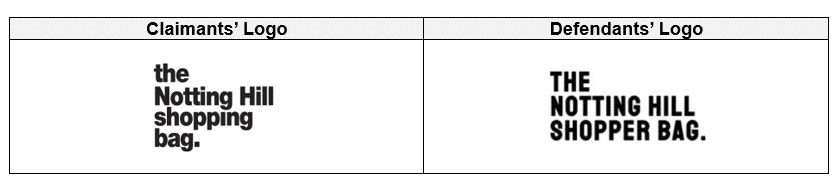
A recent case involving tote bags using logos for ‘The Notting Hill Shopping/Shopper Bag’ highlights the critical need for brands to proactively manage their IP portfolios and stay on top of both ownership and renewal of their IP rights. A key takeaway is the application of the bona vacantia doctrine, which raises important issues regarding the ownership and management of IP rights when a company is dissolved and the risk that such IP can inadvertently be left unclaimed – and therefore unprotected.
The background: speed read
In 2008/2009, Ms Courtenay-Smith began selling tote bags featuring a ‘the Notting Hill shopping bag’ logo to traders on Portobello Road.
In April 2010, she incorporated ‘The Notting Hill Shopping Bag Company Limited’ (the “Original Company”) and, in October 2013, the Original Company registered a UK trade mark for this logo (the “UK Trade Mark”).
In June 2017, a wholesaler of the bags incorporated ‘The Notting Hill Bag Company Ltd’ (the “Second Company”). In April 2018, the Original Company was voluntarily dissolved. The notice of proposed dissolution included “Upon dissolution all property rights vested in, or held in trust for, the company are deemed to be bona vacantia and accordingly belong to the Crown”.
In November 2022, two brothers (Nangialai and Ehsanullah Takanai) incorporated ‘The Notting Hill Shopping Bag Company Limited’ (the name of the dissolved Original Company) and ‘The Notting Hill Shopper Bag. Ltd’ selling tote bags with a ‘THE NOTTING HILL SHOPPER BAG’ logo.
While seeking to enforce their rights, the claimants discovered that the UK Trade Mark had not been assigned (transferred) before the Original Company was dissolved. They restored the Original Company (as of October 2023) and attempted to renew and assign the UK Trade Mark to the Second Company (it was to expire in May 2023). They sued for trade mark infringement, passing off and copyright infringement.
The outcome: no infringement
The Court dismissed all three claims, finding the following:
1. The UK Trade Mark was invalidly renewed and could not have been assigned to the Second Company – When the Original Company was dissolved in April 2018, its assets (including the UK Trade Mark) passed to the Crown as bona vacantia. Only the Crown (as proprietor) could have renewed or authorised renewal. The claimants restored the Original Company in October 2023, but by then the UK Trade Mark had already expired (in May 2023). There is a six-month grace period to renew a UK trade mark after it has expired, but the Original Company did not use this. In the absence of the trade mark registration, there could be no trade mark infringement.
Even if the UK Trade Mark had been validly renewed, the defendants could have applied to cancel the UK Trade Mark for non-use, as there had been no authorised use for a consistent five-year period when the Original Company was dissolved.
2. The Second Company had not established sufficient goodwill for passing off – The passing off claim was unsuccessful because the Second Company had not established the necessary goodwill in the brand at the relevant time. Any goodwill generated by the Original Company was lost on its dissolution in 2018, and no assignment was entered into to preserve it (the assignment in 2023 was too late). While the Second Company could show limited trading activity from 2018 (the dissolution of the Original Company) to 2022 (when the defendants started selling the tote bags), it was not enough to support the passing off claim.
3. There was no copyright infringement of the logo – Although Ms Courtenay-Smith had artistic copyright in her logo design (e.g. there were creative choices of the left justification over 4 lines, the t in lower-case and the full stop at the end) the scope of copyright protection was narrow because of the simplicity of the design. The defendants’ logo differed in certain ways (including font, capitalisation and the text layout over 3 lines) so was found not to have copied a ‘substantial part’ of the original logo. As such, the threshold for copyright infringement was not met.
Top tips from this case
Maintain IP Records – Keep an up-to-date record of all IP rights owned and used by your brand and diarise all renewal dates, so that important trade marks (and registered designs and patents, if relevant) do not lapse. An IP lawyer can assist and send you reminders.
Due diligence before dissolution – If part of a group restructure involves dissolving a company, ensure IP due diligence is carried out. All IP must be validly assigned before dissolution. After dissolution, the rights pass to the Crown (bona vacantia), and any subsequent renewal or assignment may then be invalid.
Restoration is risky – It is possible to restore a dissolved company and apply to reclaim its assets but this may require a court order and there are risks of IP rights expiring and abandoned goodwill. Similarly, buying back assets from the Crown may not be straightforward and requires additional payment.
Use it or lose it – Ensure that any trade marks are put to genuine use within the relevant period, so that they are not liable to be revoked for non-use. Keep clear records of such use.
Simplicity is harder to protect – ‘Quiet luxury’ and minimalism may be on trend but keep in mind that simple logos and designs benefit from more limited copyright protection. This case also shows the hurdles faced when trying to claim copyright infringement rather than seeking to enforce registerable rights. Seek advice as to whether there are advantages to protecting such logos/designs as registered rights such as trade marks or designs.
Unlock 24-hour access to our exclusive content including on-demand webinars by submitting your details using the form below:
"*" indicates required fields
Manage Consent
To provide the best experiences, we use technologies like cookies to store and/or access device information. Consenting to these technologies will allow us to process data such as browsing behaviour or unique IDs on this site. Not consenting or withdrawing consent, may adversely affect certain features and functions.
Functional
Always active
The technical storage or access is strictly necessary for the legitimate purpose of enabling the use of a specific service explicitly requested by the subscriber or user, or for the sole purpose of carrying out the transmission of a communication over an electronic communications network.
Preferences
The technical storage or access is necessary for the legitimate purpose of storing preferences that are not requested by the subscriber or user.
Statistics
The technical storage or access that is used exclusively for statistical purposes.The technical storage or access that is used exclusively for anonymous statistical purposes. Without a subpoena, voluntary compliance on the part of your Internet Service Provider, or additional records from a third party, information stored or retrieved for this purpose alone cannot usually be used to identify you.
Marketing
The technical storage or access is required to create user profiles to send advertising, or to track the user on a website or across several websites for similar marketing purposes.