Estimated reading time: 7 minutes
A negotiated sale process supported by the target board is usually the simplest route for acquiring a private company. It provides a buyer with access to due diligence, management engagement and a negotiated route to ownership.
However, this route is not always available. Where the board supports an alternative transaction or is unwilling to engage, a prospective buyer may instead approach shareholders directly through what is known colloquially as a hostile offer or hostile tender offer.
This article considers some of the principal issues for a bidder pursuing a hostile or competing offer for shares in a UK-incorporated private company.
A direct offer to shareholders need not seek 100% ownership. It may instead provide an initial or enlarged stake, voting influence and a platform for engagement without the board’s cooperation.
The bidder should decide at the outset whether it seeks an economic foothold, a blocking stake, control or full ownership. That objective determines the shares sought, acceptance condition, any scaling mechanism and the plan for a partial outcome.
| More likely to be useful | Less likely to be useful |
|
|
Since 3 February 2025, the Takeover Code has applied principally to UK-registered companies whose securities are admitted to trading on a UK regulated market, a UK multilateral trading facility or a stock exchange in the Channel Islands or the Isle of Man, and for two years after that quotation ceases. Transitional provisions expiring on 2 February 2027 may also catch certain other public and private companies.
The Code perimeter should therefore be checked at the outset. The remainder of this article assumes that the target and transaction fall outside the Code.
The bidder should carry out a detailed review of the target’s articles of association, any shareholders’ agreement and the share register. While the target’s articles of association should be publicly available at Companies House, access to a shareholders’ agreement will ordinarily depend on the cooperation of the relevant parties. A bidder may also need to use the statutory process to inspect the target’s register of members.
In doing so, a bidder should seek to establish whether transfers are subject to directors’ discretion, pre-emption rights or other restrictions, whether drag-along provisions might be available, the voting thresholds needed to secure control, amend the articles or pass other key resolutions and whether any important change of control or regulatory approvals are likely to be engaged.
The answers to these questions, or any difficulty in obtaining these answers, will shape the bidder’s strategy. Acquiring a majority of the voting rights may provide the ability to pass ordinary resolutions, but may not be enough to allow the bidder to implement its intended plans for the business. Further, if the directors refuse to provide the requisite information, this can cause issues with the deliverability of the offer.
The board is not generally obliged to engage with an unsolicited bidder, provide due diligence or treat competing bidders identically, and may recommend an alternative transaction.
The board must nevertheless comply with its statutory duties. Defensive actions involving share issues, capital changes, distributions, material disposals or a refusal to register transfers must be taken consistently with those duties, including the duty to exercise powers only for proper purposes, and not simply to entrench the board or frustrate the offer.
The board may not be obliged to provide an unsolicited bidder with business information. Selling shareholders are also likely to offer only title, capacity and authority warranties relating to their shares.
The bidder may therefore receive little protection concerning the target’s business. The remaining risk must be addressed through price, conditions or structure
A private company offer is not usually subject to the Takeover Code in the way that a public takeover is. That gives parties flexibility, but it also means there is little in the way of a prescribed framework for process, disclosure or shareholder protections.
The bidder will therefore need to create a process which is legally robust and readily understandable for shareholders, as well as building in a user-friendly acceptance process. Depending on the circumstances, this may involve an offer document, a form of acceptance, stock transfer forms, powers of attorney and arrangements for missing share certificates. The documentation, and shareholder communications, should make clear the key details of the offer including any acceptance deadline, whether (and if so, how) the offer is conditional, and the consideration and payment process.
These mechanics become especially important in a competing bid scenario. In such a case it will be imperative to distinguish the mechanics of the bidder’s offer from the competing offer’s and to outline how such offers might interact. The documentation should also be clear about the point at which an accepting shareholder becomes irrevocably committed, and the respective timing of contractual commitment, beneficial ownership and registration of legal title. This can be critical where a shareholder is considering, or has entered into, another proposed transaction.
Support from key shareholders can be decisive, both commercially and legally. A bidder may seek irrevocable undertakings to accept its offer, or undertakings not to support a competing transaction, before incurring the cost and effort of making a more general offer to shareholders.
The appropriate form of undertaking will depend on the circumstances. A hard commitment may provide valuable certainty, but can be difficult to obtain where a higher competing offer is possible. Equally, an overly broad restriction may prove commercially unattractive to shareholders or create avoidable enforceability issues. Financial promotion rules, and the statutory rules pertaining to the squeeze-out procedure should also be considered in connection with any irrevocable undertakings.
A bidder should decide at the outset whether it is prepared to acquire the shares if it does not achieve full ownership. The thresholds generally considered as part of this process are:
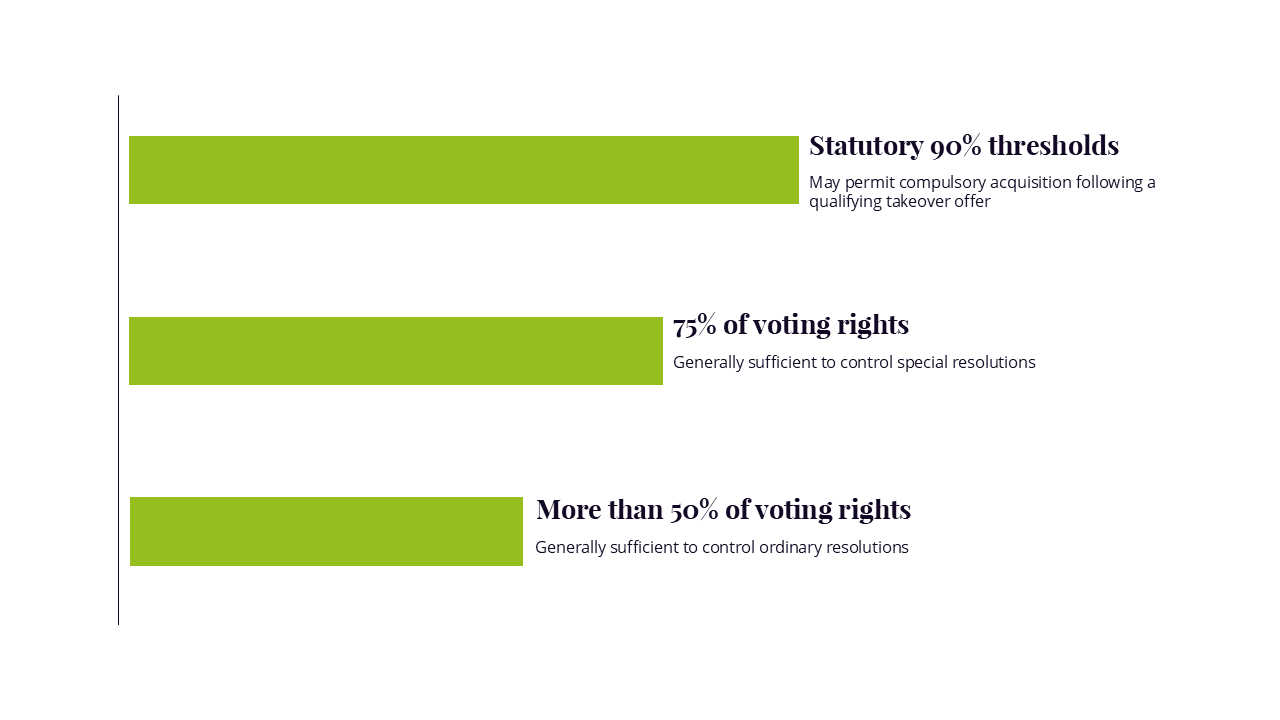
A bidder which has, by virtue of acceptances of a qualifying takeover offer, acquired or unconditionally contracted to acquire at least 90% in value of the shares to which the offer relates and, for voting shares, 90% of the voting rights attaching to those shares, may be able to use the Companies Act compulsory acquisition process to acquire the remaining shares. This compulsory acquisition regime can be a powerful route to full ownership as it can enable the bidder to squeeze out non-accepting shareholders on the terms of the offer. However, the detailed statutory requirements, offer structure, treatment of different share classes and the bidder’s existing shareholding must all be analysed carefully at the outset.
If full ownership is not achieved, the bidder will need a clear plan for governance, minority shareholders, future funding and possible exit routes.
A private offer can engage a range of regulatory and legal considerations. These may include financial promotion rules, data protection and sector-specific change-of-control approvals.
Communications with shareholders should be accurate, balanced and tailored to the intended recipients. Particular care is needed where an offer includes non-cash consideration, such as loan notes or shares, or where the shareholder base includes individuals, overseas holders or a significant number of small shareholders.
An invitation or inducement to shareholders to accept an offer may engage the financial promotion restriction under section 21 of the Financial Services and Markets Act 2000. Article 62 of the Financial Promotion Order may be available where the transaction involves at least 50% of the voting shares or its object may reasonably be regarded as the acquisition of day-to-day control, subject to its other conditions. It should not be assumed to cover a passive or non-controlling investment; if it is unavailable, another exemption or approval by an authorised person may be required. The separate exemption for takeovers of relevant unlisted companies ordinarily requires the target board’s recommendation and will therefore not usually assist on a hostile offer.
A hostile offer for a private company is not a conventional M&A transaction. It requires a bespoke combination of corporate analysis, offer mechanics, shareholder engagement, regulatory planning and disciplined communications.
For bidders, the key is to understand the target’s constitutional constraints early, make the route from acceptance to ownership clear, and build a credible strategy for both a successful acquisition and a partial acceptance outcome.
If you would like to discuss any of the issues outlined in this article, get in touch with a member of our M&A team.

