
Estimated reading time: 5 minutes
Relationships with retailers, brand positioning as against adjacent brands, and the consequences of price fixing make dealing with Recommended Retail Prices (“RRP”) a difficult issue throughout the industry.
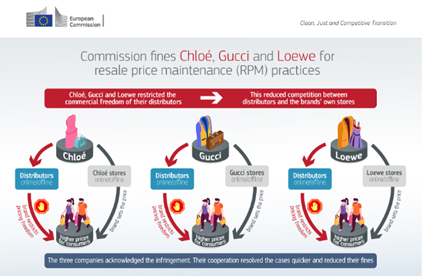
Last Autumn Gucci, Chloé, and Loewe were found by the EU Commission to have breached EU competition law by fixing resale prices of their retailers. According to the EU Commission Gucci, Chloé, and Loewe “restricted the ability of both their online and brick-and-mortar retailers, which are independent resellers, to set their own retail prices for almost the entire range of products designed and sold by Gucci, Chloé, and Loewe”.
These restrictions included preventing retailers from diverging from the recommended retail pricing and maximum discount rates. In short, “these anticompetitive practices by Gucci, Chloé, and Loewe deprived the retailers of their pricing independence and reduced competition between them. At the same time, Gucci, Chloé, and Loewe aimed to protect their own sales from competition from their retailers”.
But sometimes attempts are made by brands to achieve a similar result by other means.
Where a brand offers increased margins to selected boutiques and key independent customers – say moving to from a 2.8 to a 3.0 markup from cost to RRP across key categories – there can be a competition law issue where the offer shapes how resale prices are set in practice.
Although suppliers are free to indicate a recommended price, the law requires that retailers retain genuine autonomy over their final selling prices. The difficulty arises where the commercial structure makes deviation from that benchmark unattractive or commercially risky.
A pricing model built around a fixed relationship between cost and retail price may act as more than a reference point. It can signal the level at which the brand expects products to be sold and, crucially, tie retailer profitability to adherence to that level. Where retailers depend on those margins, discounting may become economically unviable. Competition rules are concerned not only with express obligations but also with softer forms of influence, including financial incentives or trading advantages that steer behaviour.
The selective nature of the enhanced margins adds a further dimension. While differentiation between retailers is not inherently unlawful, it may distort competition if it advantages certain stockists – say selected boutiques and key independent customers – over others in a way that dampens price rivalry.
Even without explicit enforcement, retailers may align their prices to avoid jeopardising their commercial position, leading to reduced variation in retail prices across the market.
Further from both a UK and an EU competition law perspective, the risk is heightened by the possibility that the supplier monitors pricing behaviour or structures its commercial arrangements in a way that rewards compliance.
Some UK and EU brands have been looking to classify their stockists. With reference to this a framework that groups retailers according to defined criteria and allocates benefits—such as access to products, improved terms or closer support—can be legitimate under competition law, particularly where it reflects brand strategy or quality standards. But its acceptability depends on how it functions in reality rather than how it is described.
The criteria used must be appropriate and no more restrictive than necessary. If the criteria have the effect of sidelining particular types of retailer, limiting entry, or concentrating key products within a narrow group, competitive pressure between sellers of the same brand may be weakened. The introduction of tiered benefits can intensify this effect by reinforcing differences in commercial position.
There is also a risk that such a system indirectly shapes pricing conduct. If retailers perceive that maintaining or improving their classification depends on adopting certain pricing practices, this may discourage independent price setting. Competition law is concerned with outcomes as well as form, and arrangements that lead to parallel pricing behaviour may attract scrutiny. The central question is whether retailers remain free, in a meaningful sense, to compete with one another, particularly on price.
A finding that a brand has infringed UK or EU competition law can have significant legal, financial and commercial consequences. The most immediate risk is the imposition of substantial fines by the UK Competition and Markets Authority or the EU Commission (and in some instances by the national competition law authority of an EU member state). These penalties can reach up to 10% of the undertaking’s worldwide turnover, which means that even relatively narrow infringements can result in very large financial exposure, particularly for brands operating internationally.
Beyond regulatory fines, the brand may face follow-on damages actions from affected parties, including retailers or consumers who claim they have suffered loss as a result of the unlawful conduct. In recent years, there has been a marked increase in private enforcement, including collective actions, which can further increase financial liability and prolong the impact of an infringement.
There are also important contractual and operational consequences. Agreements or provisions that infringe UK or EU competition law are unenforceable, which can disrupt existing distribution arrangements and require renegotiation of commercial terms. A brand may also be subject to directions from the CMA or EU Commission to bring the infringement to an end, which can involve changes to pricing policies, distribution structures or internal practices. In some cases, regulators may impose ongoing monitoring or require commitments to ensure future compliance.
Reputational damage is another significant consideration. A public finding of anti-competitive conduct can affect relationships with customers, suppliers and investors, and may attract negative media attention. For fashion brands, this can translate into a loss of trust and potential impact on sales.
At an individual level, there can also be consequences for directors and senior managers. In the UK, individuals may face disqualification from acting as a company director for a period of time, and in certain cases—particularly involving cartel activity—there may even be criminal liability.
Finally, an infringement often leads to increased internal compliance burdens. Businesses typically need to implement enhanced competition law training, revise policies, and monitor commercial practices more closely. Taken together, these consequences mean that competition law breaches can have far-reaching and long-lasting effects well beyond the initial regulatory finding.
Competition law is concerned not only with explicit pricing obligations but also with commercial arrangements that, in practice, reduce retailers’ freedom to compete on price.
Get it wrong and a brand is most likely to pay more than the recommended retail price.