Estimated reading time: 3 minutes
Estimated reading time: 3 minutes
As September comes around once again, so too does a new raft of developments in employment law. In this update, we round up pertinent events from the end of July onwards and what to look out for next in 2026.
Looking back: Summer 2026 updates
July
ACAS opened a consultation on a revised draft Code of Practice on disciplinary and grievance procedures. In summary, key changes from the current Code include:
- Revised terminology: The CoP references (for the most part) “workers” rather than the previous “employees”.
- Informal resolution is brought within the statutory framework. Including in respect of the potential uplift of up to 25% tribunal awards for an unreasonable failure to follow the Code.
- New section on mediation and facilitated conversations.
- Expanded guidance on suspension.
- Reasonable adjustment section reflects the requirements of the Equality Act 2010.
- Right to be accompanied; encouraging employers to permit employees to be accompanied in instances where the statutory right may not apply.
The consultation closes on 23 September 2026.
August
- The Equality and Human Rights Commission’s Code of Practice for Services, Public Functions and Associations came into effect. For more information see our previous article.
- The Supreme Court case Augustine v Data Cars Limited [2026] UKSC 30 confirmed that part-time status does not need to be the sole cause of less favourable treatment to permit a claim under Reg 5. of the Part-time Workers (Prevention of Less Favourable Treatment) Regulations 2000. As such, in summary, a worker can seek to rely on the right not to be treated less favourably than a comparable full-time worker even if their part-time status is an effective cause, and not the sole cause, of said treatment.
- The Code of Practice: Electronic and workplace balloting came into force. This document is for trade unions, employers and union members and sets out provisions on the conduct of electronic and workplace balloting for statutory trade union ballots.
Looking ahead: Autumn 2026 and beyond
September
The FCA’s new rules and guidance to help tackle non-financial misconduct came into effect: FCA: Non-financial misconduct in financial services. The new rule, Code of Conduct (COCON) 1.1.7FR, extended the scope of the conduct rules in non-banking firms to cover bullying, harassment or violence against colleagues, where it relates to an individual’s role. The new Handbook guidance (PS25/23) seeks to help firms apply COCON and the fit and proper test. For more information, visit our Non-Financial Misconduct hub.
October
- The time limit for bringing a claim to the Employment Tribunal in England and Wales will increase to six months in respect of relevant acts that take place on or after 1 October. However, in summary, claims with a relevant date before 1 October 2026 remain subject to their previous time limit, which in most cases was three months.
- Changes to workplace harassment law
- Employers to take ‘all reasonable steps’ to prevent sexual harassment of their employees.
- Obligation on employers not to permit the harassment of their employees by third parties.
- Industrial relations framework changes
- Duty to inform workers of their right to join a trade union.
- Strengthening of trade unions’ right of access.
- Reinstatement of the two-tier code to ensure outsourced private sector employees are offered no less favourable terms and conditions to employees transferred from the public sector. Further detail and the exact implementation date in October remains outstanding.
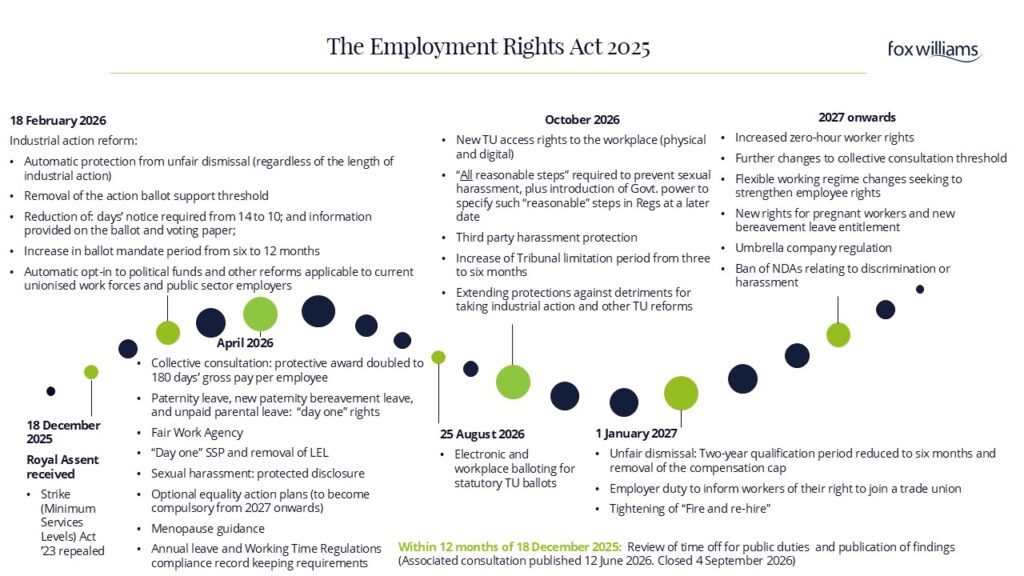
Updated Employment Rights Act 2025 implementation timeline

Our team regularly publish updates on our website. If you have any questions, please contact one of the experts in our team here.
This overview is general guidance and is aimed at employers that are currently non-unionised and do not operate in social care. It should not be relied upon without first taking separate legal advice. Neither the author nor Fox Williams LLP accepts any responsibility for any consequences resulting from reliance on the contents of this document.