Impactful changes under the Employment Rights Act 2025 (ERA 25) are imminent. In this article we break down what is changing in April ’26 and provide an action checklist for employers that are currently non-unionised and do not operate in social care.
Retention of annual leave records
A (very) late joiner to the 6 April reforms was the requirement for employers to retain annual leave records for six years. In summary, employers must keep records that are adequate to show that the organisation has complied with the law in respect of annual leave and pay entitlements, night working and payment in lieu of leave on termination. This is applicable to irregular and part time workers as well as full time workers.
Action checklist:
Ensure an accurate record-keeping system is in place to track and store the relevant annual leave and pay, night working and payment in lieu of leave on termination data.
Brief staff on the new requirement to ensure that records are retained for six years.
Schedule regular reviews to ensure the organisation is compliant and maintaining records as required ahead of a potential audit by the Fair Work Agency in 2027 (see below).
Statutory Sick Pay (SSP)
SSP is now payable from day one of the first full day of absence, as opposed to following a three-day waiting period. Also, the Lower Earnings Limit is removed and the rate at which SSP is paid will be at the lower of: the prescribed weekly rate or 80% of the employee’s earnings. The weekly rate increased to £123.25 from 6 April 2026 – 5 April 2027.
Action checklist:
Any sickness absence policy wording and template letters that refer to the three-day waiting period and Lower Earnings Limit rate are to be amended. Consider if any prescriptive wording on an SSP calculation requires the new reference to the lower of the prescribed weekly rate or 80% of the employee’s earnings.
Instruct payroll of the changes.
Confirm the change to the individuals who implement HR policies and record SSP entitlements.
Paternity, parental and bereaved partner’s paternity leave
Effective 6 April 2026, the following were removed:
the one-year qualifying period for unpaid parental leave.
the 26-week qualifying period for paternity leave.
the restriction preventing employees from taking paternity leave or receiving statutory paternity pay following a period of shared parental leave.
Therefore, parental leave and paternity leave became “day one” rights. However, entitlement to statutory paternity pay remains unchanged.
Bereaved partner’s paternity leave is a new entitlement that will also be a “day one“ right. In summary, it allows an eligible employee to take up to 52 weeks’ leave to look after a child where the mother, or primary adopter, or intended parent having a baby through surrogacy, dies within the first year of the child’s birth, or placement for adoption, on or after 6 April 2026.
Action checklist:
Amend policy wording and any template letters that refer to the historic qualification requirements for paternity and/or parental leave.
Draft new policy wording setting out the right to bereaved partner’s paternity leave. Publish/circulate as required.
Provide training to the individuals who implement HR policies and entitlements to ensure individuals are not misinformed about qualifying service and that they understand the new entitlement to bereaved partner’s paternity leave.
Collective Consultation
From 6 April the maximum protective award for failure to collectively consult increased from 90 to 180 days’ gross pay per affected employee. NB as employment tribunals may apply a 25% uplift where an employer has unreasonably failed to comply with the Dismissal and Re-engagement Code of Practice, financial exposure may increase considerably.
Action checklist:
Cascade this information to C-Suite and senior business heads to ensure that there is a clear understanding of the increase in financial liabilities in the event of a failure to collectively consult.
Review current internal procedures and template documents used for collective consultation exercises to ensure they are compliant. Consider taking advice on trigger points, representative election and communications, overall timing and process.
Evaluate the viability and benefits of creating a permanent employee representative forum, particularly if the organisation is likely to trigger the collective threshold regularly.
Also, the newly published FWA web pages include information on the reporting process. In summary, individuals are able to report concerns about organisations to the FWA directly about the following:
Pay and/or work right concerns via an online form; and
Serious abuse or exploitation at work (including psychological abuse) via an online form, an email address or phone number.
Review the key FWA documents here: Fair Work Agency – GOV.UK. Educate senior staff and business heads to ensure that there is a clear understanding of the FWA’s powers to investigate and penalise organisations.
Consider nomination of an individual who will respond to any contact made by the FWA and act as a key liaison.
Anticipate FWA audit and investigation of record keeping and compliance with requirements relating to the following: the National Minimum Wage, annual leave records (see above – the FWA documents appear to indicate FWA holiday pay enforcement will commence in 2027), fair treatment by employment agencies, protection from serious labour exploitation and abuse, payment of employment tribunal awards.
Whistleblowing
While arguably sexual harassment disclosures are covered by the current whistleblowing legislation, ERA 25 clarifies the position. Disclosures qualifying for protection now explicitly include sexual harassment. Whether it has occurred, is occurring or is likely to occur.
Also, as of 6 April, the following government guidance on whistleblowing has been published:
Review current whistleblowing policies and government guidance documents. Consider updates, including if specific references to the list of disclosures that qualify for protection require amendment to include sexual harassment has occurred, is occurring or is likely to occur.
Consider including a new reference to whistleblowing in sexual harassment policy wording.
Confirm changes to the individuals who deal with whistleblowing complaints.
Brief managers who handle complaints from team members; and
Staff who monitor any whistleblowing reporting channels such as a whistleblowing hotline.
Annual changes to the rates and limits:
From 1 April 2026 National Living Wage (age 21 and over) hourly rate increases to £12.71 per hour.
Statutory Maternity Pay, Statutory Paternity Pay, Statutory Adoption Pay, Statutory Shared Parental Pay, Maternity Allowance, Statutory Parental Bereavement Pay and Statutory Neonatal Care Pay increases to £194.32 per week effective 5 April 2026.
Maximum compensatory award for unfair dismissal for dismissals taking place on or after 6 April but before 1 Jan 2027: £123,543 (up from £118,223).
The statutory limit on a gross week’s pay: up to £751, effective 6 April.
Action checklist:
Review any potential practices that could create technical underpayments for National Living Wage purposes, such as salary sacrifice arrangements. Check compliance for lower-paid staff and apprentices. Noting that the relevant apprentice rate is dependent on the individual’s age and their year of apprenticeship.
Instruct payroll to implement the relevant updates.
Optional equality action plans and menopause guidance
On 4 March a large volume of information was published by the government on equality action plans and menopause guidance. The action plans are due to become mandatory from Spring 2027 for employers with 250 or more employees.
Action checklist:
Begin reviewing the government’s new web pages on the topic as an introduction to the mandatory requirements from 2027. Action plans: list of actions – GOV.UK We will continue to keep you informed via HRLaw ahead of the legal implementation requirements.
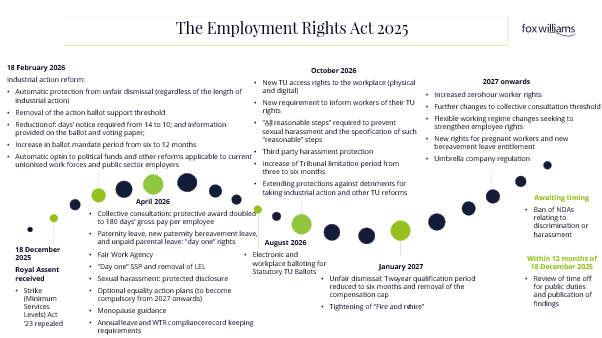
Updated ERA 25 implementation timeline
This overview is general guidance. It should not be relied upon without first taking separate legal advice. Neither the author nor Fox Williams LLP accepts any responsibility for any consequences resulting from reliance on the contents of this document.
Unlock 24-hour access to our exclusive content including on-demand webinars by submitting your details using the form below:
"*" indicates required fields
Manage Consent
To provide the best experiences, we use technologies like cookies to store and/or access device information. Consenting to these technologies will allow us to process data such as browsing behaviour or unique IDs on this site. Not consenting or withdrawing consent, may adversely affect certain features and functions.
Functional
Always active
The technical storage or access is strictly necessary for the legitimate purpose of enabling the use of a specific service explicitly requested by the subscriber or user, or for the sole purpose of carrying out the transmission of a communication over an electronic communications network.
Preferences
The technical storage or access is necessary for the legitimate purpose of storing preferences that are not requested by the subscriber or user.
Statistics
The technical storage or access that is used exclusively for statistical purposes.The technical storage or access that is used exclusively for anonymous statistical purposes. Without a subpoena, voluntary compliance on the part of your Internet Service Provider, or additional records from a third party, information stored or retrieved for this purpose alone cannot usually be used to identify you.
Marketing
The technical storage or access is required to create user profiles to send advertising, or to track the user on a website or across several websites for similar marketing purposes.